
What separates Qi in TCM vs. mystical “woo-woo” Qi described in martial arts? “Internal qi and external power are completely different. One deals with functions of the body and of mind to be able to strengthen and control the bodily functions, and the other is being able to extend a force through space.” -Dr. Alex Shpigel (International Lei Tai Heavy weight champion and TCM doctor.)
Tai Chi Massage:
Tai Chi massage is a modality that was taught to me by my massage teacher Sifu Nancy Bloomfield back in 2005 when I attended Qi elements school of Tai Chi and Massage. She was a master level massage therapist who learned this modality from C.C. Liu in DC’s Chinatown. C.C. Liu was a student of Xiang Yangho (Hsiung Yang-ho) of Taiwan who was student of Yang Jianhou and Yang Shaohou. Xiang Yangho studied with Yang Jianhou primarily and with several other 2nd generation Yang teachers (without the Yang Family name). As a military man, his basis was southern Shaolin.


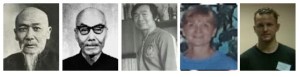
Oral history
Some of the back story behind Tai Chi massage is that in the old schools of Tai Chi Chuan, the younger students had to do massage on the senior students for several reasons to understand:
1. Various Acu-points for cavity strikes, acupuncture/acupressure healing, and for meditative Neijia exercises.
2. Muscle and Tendon groups for seizing and grasping tendons/muscles, and for massage healing.
3. Joint and Bone locations for breaks, dislocations, and traumatology healing and bone setting.
The deeper the more advanced Tai Chi senior student went into training and fighting, various injures were occurred and knowing how to heal it was just as important than knowing how to injure someone. Either way, it was for both knowledge and experience of anatomy for both fighting and healing.
Matt is certified with the Virginia Board of Nursing Massage Therapist and bodyworker license. His main job however is as an acupuncturist in which he may use Tui-na in therapy.
Tai Chi massage differs from other forms of massage in that it is a experience which enhances a deep feeling of contentment. The massage is very relaxing and works not only with the physical body, but with the Qi energy in the channels. The techniques used vary from light strokes to deep tissue work.
Light brush strokes trace the channel lines and help them to run smoothly and efficiently. This energy work enhances the physical aspects of the massage as waves of Qi are released throughout these healing channels of the body. This technique nurtures the parasympathetic nervous system, invigorates every organ and carries life force into every cell.
Inner structure of Tai Chi massage: Bones, Muscles, and Tendons.
Bones
The human skeleton is viewed as a system that efficiently transmits biomechanical power throughout the body. The mechanical power can be transported from one end of the system to the other only if all the involved components are in proper alignment from bone to bone.
Power is in the large thigh and leg bones transport into the pelvis then the base of the spine into the scapula and ultimately forearms and hands. (In martial applications this power is used for self-defense but in massage therapy, this will energize and maximize the strength and efficiency of the therapist’s work).
Skeletal framework is the foundation and core of our physical structure. Practice of Tai Chi activates, energizes, and transforms the bones and marrow. With the proper mind control and body alignment, one can draw energy into the bones to help remove fat and create space for marrow to grow. This enhances healthy blood cells. These cells nourish the body and help it resist disease. The marrow of flat bones produces white blood cells, the soldiers of the immune system. Healthy blood is essential for a healthy body.
The practice of Tai Chi strengthens the bone matrix, which is a storehouse of calcium. Bone matrix stores qi in an unusual way; bones is one of the few substances on earth other than quartz crystal that has piezoelectric properties. This means that the electrical charge of the bones increases in proportion to the pressure exerted on the bones. In tai chi we shift the load-bearing job from the muscles to the bones with the bone-on-bone structure. This pressure that generates. actives the energy stored in the bones.
Bone breathing uses the power of the mind to establish a flow of external qi through the fingertips and toes, which spread throughout the entire body.
When massage therapists can utilize this knowledge and incorporate the principles of tai chi with a massage, the therapist will efficiently use their energy to perform the massage, increase the intensity of the strokes, and more Qi from their feet, legs, pelvis, spine, and scapula into the client, thus creating an opportunity to enhance the health of both the massage therapist and the client.
Muscles
Unlimited power and force can be transmitted efficiently if the large muscles and bones of the legs move in harmony with the earth Qi. A good example of this is the push in the tai chi form. The structure collects the power in the legs, moves it into the pelvis and releases it in the extremities to move large objects or an opposing force. All muscles I the body must be relaxed and from of tension as Qi cannot move through rigid muscle fiber. If there is even a minimal amount of tension in the muscles, the power that is generated will be greatly diminished. In reverse, the body can absorb and deflect a great amount of force by channeling it through the body into the legs and into the ground, leaving the practitioner unharmed.
As a massage therapist, you will be challenged by many people who have extremely rigid bodies. Instead of absorbing the tension and trying to meet the challenge with Yang energy, you will absorb the tension by staying in a yin state and channel the tension into the earth. You will then be able to work on the tissue after it has released the tightness and tension.
Tendons
In tai chi practice we learn to use correct posture so that a minimal amount of energy can withstand a maximum amount of force. Proper alignment uses tendons along with muscles to create power. The tendons are elastic and store energy through stretching and winding exercises. The Achilles tendon in particular is capable of storing the energy of 1000 pound pull. The tendons act like a spring and correct posture can absorb and redirect force like a spring in a car’s suspension.
In a sense, the tendons consume and recycle energy that would otherwise be wasted. The tendons are used to absorb and rebound back the power from the opponents’ push.
In Tai Chi massage we use tendons to coil energy as we move through the long body strokes and work on the gluteus muscles. These huge muscles can create tension between the therapist and the client’s body. Instead of using tools, the therapist can incorporate the energy in the tendons to absorb the tension and pressure in the muscles and use it to create more power and friction needed to reduce the waste matter from the tissues and then soften it also.
The massage therapist must practice the tai chi routine using the skeletal, muscular, and tedious awareness to improve their massage techniques. The ultimate goal of the massage therapist is to create a tai chi form that moves them through all the postures and strokes that they need to incorporate to perform a complete massage. As the years progress, the therapist will perfect the techniques, cultivate more energy, and store energy in their body. They will receive the same benefit that one would gain from practicing tai chi every day.
Images of the muscle-tendon regions in TCM

Tui-Na and Bone setting.

 Yongnian Tai Chi