
I-Ching series for all aspects of life, martial arts, medicine, philosophy, Tao.

Meditate, ask a sincere question, and cast the I-Ching using the 3 coin method. If you don’t know the 3 coin method find out here.
Read the Hexagrams below from your cast. If it changed into another hexagram, read that one too!

Martial: the martial portion is based on 3 things.
1: the 64 Hou tiens of Gao’s linear Bagauzhang. These represent martial principle and movement concepts. See book reference at bottom of page” “Walking the I-Ching” for complete info. If you know the 64 Houtien’s, more power to you, practice them diligently!!.
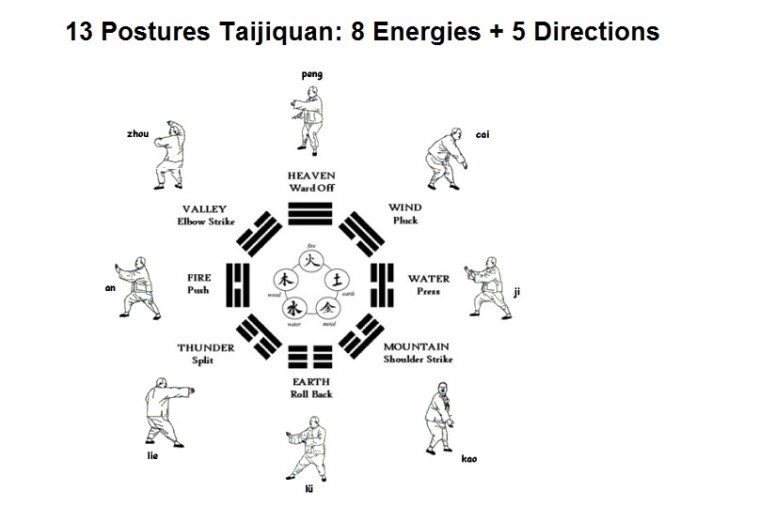
2: The Taiji: these are the postures you should drill over and over, combine them into a movement and stillness practice.
3. Bagua: these are the Animal forms you can walk and change into or use as a walking the circle or at least standing meditation postures/qigong.
Medical: only lists the channel/vessel. It is NOT for a specific acupuncture self treatment, a professional acupuncture/herbalist should do so. Your body is unique and a doctor needs to determine your treatment strategy. We are only listing the channels used in Chinese i-Ching medical theory. What you might be able to do, is when moving or holding postures, understand those skin areas, muscular/tendon regions, channels, and vessels as a form of Nei gong (inner work) training that is described. For example: Tai Yang is the back/dorsal side of the body and posterior part of arm. Meridian tracing massage may be useful as well. Try to feel the channel skin area, muscle-sinew channel, and meridian channel.
Neigong:

Gallery of Medical channels and muscle regions (almost all of them)



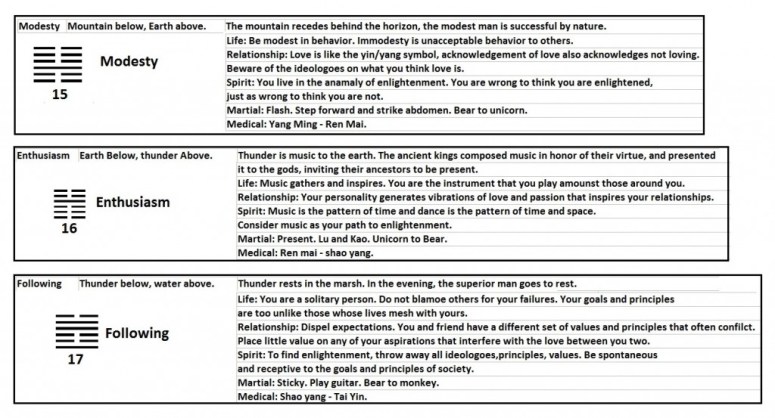
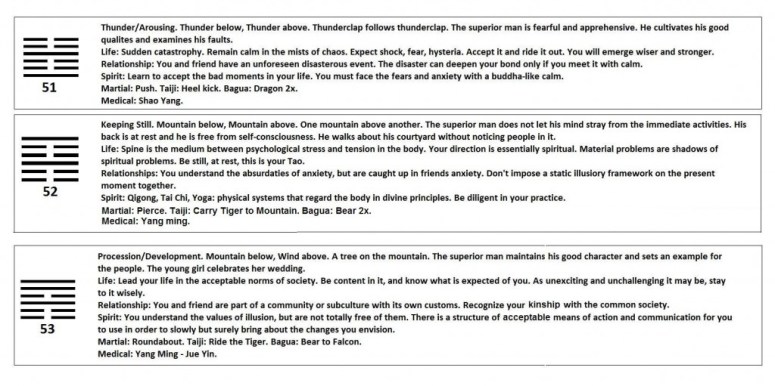
I-Ching Hexagram interpretation Below:






Gallery of ‘Tai Chi’ postures from the Yang Style of Taijiquan (Tai Chi Chuan)


Further reading:
Tai Chi Chuan and I-Ching by Da Liu.
Fundamentals of Pa Kua Chang: Park Bok-Nam
Walking the I-Ching by Allen Pittman
The Book of Changes and the Unchanging Truth: Master Ni Hua Ching.
I-Ching, new interpretation for modern times. by Sam Reifler
 Yongnian Tai Chi